Draft Budget 2026 – Analysis of budget revenues and expenditures
16/02/2026
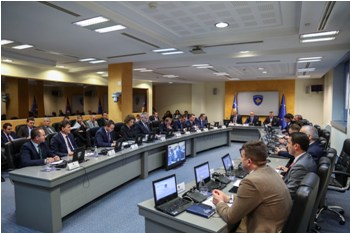
Today, GAP Institute published the report “Draft Budget 2026 – Analysis of budget revenues and expenditures.” On February 12, 2026, the Government of Kosovo approved the 2026 draft budget. The approved version is the same as the one approved by the outgoing government on October 31, 2025, and does not reflect the structure of the new government, which will now have 19 ministries. Furthermore, this draft budget was not prepared based on the Medium-Term Expenditure Framework (MTEF), which has not been approved or published for the 2026–2028 period.
Kosovos budget for 2026 foresees total expenditures of around €4 billion, an increase of 10% compared to 2025. Current expenditures are expected to rise by €279 million (+11%) to about €2.9 billion, accounting for 73% of the budget, while capital expenditures increase by €67.1 million (+7%) to €998.4 million, or 25% of the budget. During 2019–2025, spending on subsidies and transfers almost doubled in value, while capital investments increased by only about 35%. This trend limits the ability to invest in infrastructure projects, even though public investments have a very high multiplier effect on the economy.
The total central-level budget, excluding payments for public debt interest, will be around €3 billion (+9.6% compared to 2025), while the local-level budget will be about €867 million (+10.1% compared to 2025). Most of the central-level (ministerial) budget increase in 2026 goes to the Ministry of Finance, Labor, and Transfers, which will see an increase of around €174 million, or 17%. Compared to 2025, in this ministry, pension payments are planned to increase by €95 million (+20%) in 2026, maternity and child benefit schemes by €75 million (+52%), reaching €220 million, etc. The healthcare budget for 2026 is expected to reach around €396 million, a 10% increase compared to 2025, while the education budget will reach about €408.7 million, or 6% more than in 2025. Meanwhile, the justice sector budget increases by about 2%, mainly for judicial and prosecutorial institutions. In other sectors, the budget does not differ significantly from last year, nor does it address budgetary needs for effective implementation of key strategies for our economy, such as the Energy Strategy.
For the first time, the draft budget includes the 13th salary for the public sector. Although the overall increase in the wage bill remains within allowed fiscal limits, it is not aligned with the Law on Wages and represents an ad-hoc intervention in wage policy, as was the case last year with the change of coefficients.
Over 81% of the capital project budget in 2026 is for projects continuing from previous years, while new projects remain limited in number and value, mostly small-scale projects. Although improvements in investment execution were recorded in 2024 and 2025, unspent fund levels remain high considering the economy’s need for investments. Under-execution of capital investments has created significant opportunity costs for the economy and citizens. During 2021–2024 alone, capital investment execution was about €1 billion lower than planned, reflecting ongoing weaknesses in planning and implementing capital projects.
The distribution of capital investments from the central level to municipalities continues to be disproportionate relative to population and area, though more balanced from a party perspective, highlighting inequalities. Additionally, 11 municipalities approved their 2026 budgets late, though the Kosovo Assembly has the legal space to adjust budget limits between the two readings of this draft law. A positive practice in the draft budget is that the Ministry of Finance has not reduced municipal budgets due to population decline, thus not penalizing them and taking into account that investment needs remain high.
The citizen information document on the draft budget is again not published on time this year, although good practice requires a clear summary of changes and budgetary policies. Furthermore, the draft budget continues to not address the gender perspective, lacking impact analysis and measures to promote gender equality.
For more details, the report can be found by clicking here.