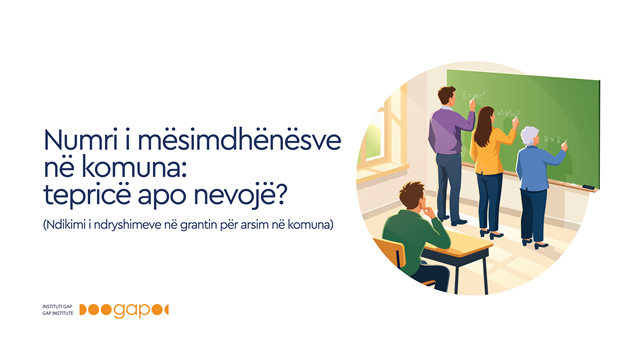
GAP Institute published the analysis “Number of Teachers in Municipalities: Surplus or Need?
30/06/2026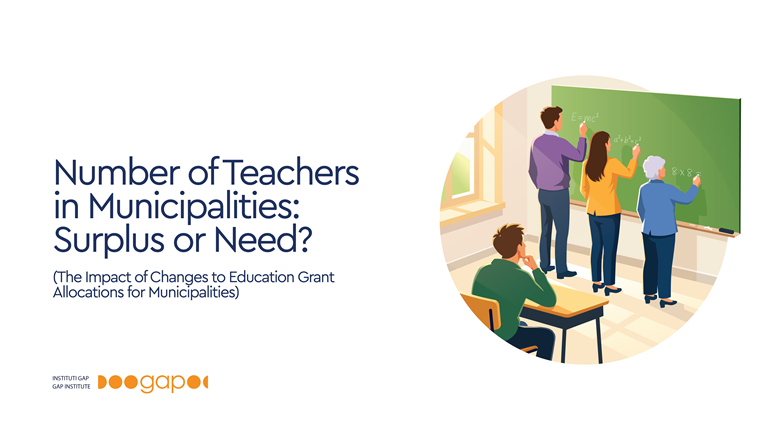
Today, GAP Institute published the analysis “Number of Teachers in Municipalities: Surplus or Need?”, which examines the impact of the stricter implementation of the teacher budgeting formula within the education grant framework.
The analysis shows that starting in 2026, the Ministry of Finance, based on the recommendations and norms of the Ministry of Education, has based the financing of teachers’ salaries on the actual number of students and the student–teacher ratio. This has highlighted significant discrepancies between the number of teachers reported by municipalities and the number approved for funding through the education grant.
The data show that, for all municipalities in Kosovo, the Ministry of Finance removed a total of 3,101 teaching positions from the education grant for 2026. This decision is expected to create a considerable financial burden on municipal budgets, with the estimated cost for all municipalities exceeding €24 million in 2026 alone. For the 25 municipalities covered by this analysis, municipalities reported 27,282 teachers for 2026, while 24,200 were approved. As a result, 3,082 teachers, or approximately 11.3% of the reported number, remained outside grant funding.
For the following year, 2027, the total number of teachers is projected to decrease by a further 263. Specifically, some municipalities will have around 463 fewer teachers within the education grant, while for the same year, the number of teachers in several other municipalities combined is planned to increase by 200.
Under these circumstances, municipalities face two alternatives: either align the number of teachers with the norms established by the Ministry of Education or retain the additional teachers by financing them through their own resources or the general grant. Choosing the second option may limit investments in the education sector and municipal development. In absolute terms, the greatest pressure to cover the salaries of “surplus” or “above-norm” teachers falls on Gjilan with over €2.5 million, Gjakova with over €2.3 million, followed by Peja, Malisheva, Podujeva, Rahovec, Suhareka, Skenderaj, and South Mitrovica.
The analysis emphasizes that this situation is not only a consequence of the funding formula but also reflects a deeper structural problem in pre-university education. For more than a decade, the number of students in Kosovo has continuously declined, while the number of teachers and schools has not adjusted at the same pace. In the 25 municipalities analyzed, the number of students decreased from 300,429 in the 2023/2024 school year to 279,465 in 2026/2027, representing a decline of nearly 21,000 students.
Therefore, GAP Institute assesses that municipalities should initiate a well-planned process of reorganizing the school network and managing education staff, based on accurate data on student numbers, classes, staffing needs, the geographical distribution of schools, and the actual costs of operation. This process should be part of a sustainable reform aimed at adapting the education system to demographic and financial changes.
The full analysis can be found here.
GAP Institute is supported by Kosovar Civil Society Foundation (KCSF) program ‘EJA Kosovo’, co-financed by the Swiss Agency for Development and Cooperation (SDC) and Sweden.