GAP Institute published the analysis “Did the increase in salaries improve the work dynamics of Municipal Assemblies?”
01/04/2026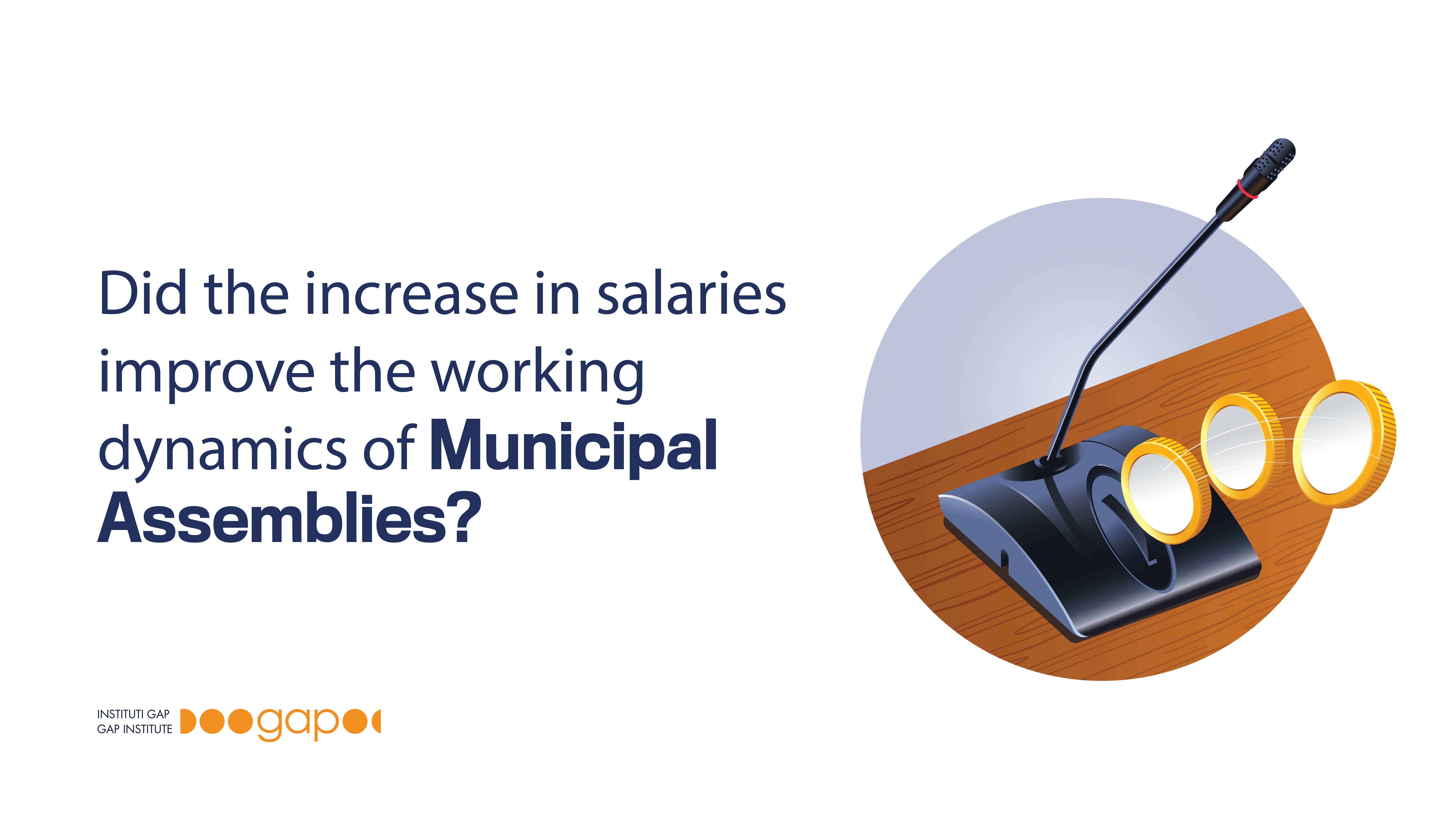
Today, GAP Institute has published an analysis titled “Did the increase in salaries improve the work dynamics of Municipal Assemblies?”
The Law on Public Sector Salaries, implemented from 2023 onwards, has significantly changed the way financial compensation is structured in public administration, particularly at the local government level. In the context of municipal assembly members, this reform has led to a noticeable increase in compensation levels. Before the entry into force of the Law on Salaries, assembly members received a uniform compensation of 150 euros as a base salary and 50 euros per session, with no distinction between large, medium, and small municipalities. After the law came into effect, in the capital city a coefficient of 6 results in a salary of 660 euros, while in other municipalities coefficients range from 5.3 to 5.9, creating a differentiated scale by municipality, where the lowest salary for an assembly member in a smaller municipality is 583 euros.
The expectation that higher salaries would lead to increased motivation is reasonable, as financial compensation is considered one of the most important factors influencing the quality and level of effort. This is particularly relevant for municipal assembly members, as insufficient compensation until the end of 2022 often pushed local elected officials to maintain other jobs to secure additional income for covering expenses. In this sense, the increase in salaries makes greater institutional engagement more likely.
However, the findings suggest that this increase in salaries has not been accompanied by an improvement in the work dynamics of municipal assemblies. Following the salary increase from the beginning of 2023 onwards, some indicators measuring municipal assembly performance show limited or minimal improvement, while most others indicate a decline. The number of municipal assembly meetings across seven municipalities was 81 in 2022, 91 in 2023, and dropped to 85 in 2024. This indicates that the first year after the increase (2023) saw a rise compared to the baseline year, but this trend was not sustained in 2024, when the number of meetings returned to a level similar to 2022.
The total duration of meetings also shows a negative trend. The time spent in sessions by municipal assemblies in seven municipalities was 285 hours in 2022, around 286 hours in 2023, and declined to 271 hours in 2024. Thus, the increase in 2023 was minimal, while 2024 shows a noticeable decrease in time spent in meetings. Meanwhile, normative productivity does not show improvement following the salary increase; on the contrary, it declines: in 2022, 26 regulations and 540 decisions were adopted; in 2023, 35 regulations and 477 decisions; and in 2024, only 10 regulations and 442 decisions.
It is important to emphasize that these are quantitative indicators that do not directly measure the quality of debate or the impact of decisions. However, as comparable indicators over time, they provide a useful overview of the pace and intensity of municipal assembly work, particularly in relation to changes in financial compensation.
The full analysis is attached and can be accessed by clicking here.
GAP Institute is supported by Kosovar Civil Society Foundation (KCSF) program ‘EJA Kosovo’, co-financed by the Swiss Agency for Development and Cooperation (SDC) and Sweden.